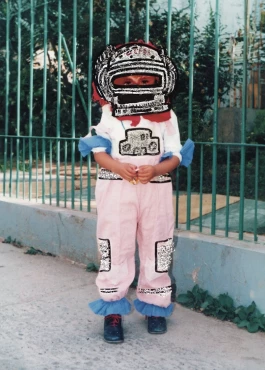
Estefanía Muñoz Cabrera (Illapel, Coquimbo Region, Chile, 1986) is a visual artist of Diaguita origin. Her practice stems from the Choapa Valley, where she researches the history of the territory and the Diaguita heritage through installation, photography, video, performance and textiles.
She holds a degree in Visual Arts from Universidad UNIACC and a Master's in Research and Photographic Creation from Universidad Finis Terrae. She has exhibited in Chile, Italy and Spain, and has completed artist residencies in Amatrice and Sicily, Italy, and in San Cristóbal de las Casas, Mexico. Her work has been supported by Fondart Regional on several occasions.
In 2023 she received the Regional Award for Culture, Arts and Heritage of the Coquimbo Region. In 2026 she was recognized in Illapel for her artistic career and her contribution to the development of the visual arts in the municipality.
Statement
My artistic practice is built from a situated relationship with the territory of Choapa, understanding the landscape not only as a geographical space, but as a body traversed by memories, transformations, silences and forms of resistance. My work draws on archives, photography, video, installation, textiles and various materials linked to the territory. I am especially interested in the relationships between memory, ruin, landscape, coloniality and the Diaguita worldview, as well as the ways in which certain knowledges, languages and experiences persist, disappear or transform over time. In my processes, documentary research, family and collective memory, observation of the landscape and material experimentation coexist. Adobe, wood, fibers, metals, found objects, photographs and audiovisual records appear as bearers of stories and as devices capable of activating other readings of the territory. Through these materialities I seek to generate tensions between past and present, presence and absence, memory and oblivion, understanding artistic practice as a way of recovering, questioning and reimagining what persists in territories and in bodies.
Contact